The four numbers that matter
Every panel sold in the UK comes with a datasheet. Ask for the one for the exact model number on your quote, because brands sell several variants under one name and the figures differ between them.
1. Module efficiency
The share of sunlight the panel turns into electricity. Higher efficiency means more watts from each square metre, so it matters most on small, split or partly shaded roofs. On a large unshaded roof, a slightly lower-efficiency panel at a lower price can deliver the same annual output for less money.
2. Temperature coefficient
Output falls as cells heat up. The coefficient (for example −0.24%/°C) says how much power is lost per degree above 25°C. Panels on a dark roof on a summer afternoon run well above air temperature, so a smaller number is worth having even in Britain.
3. Degradation and end-of-warranty output
All panels lose a little output each year. The datasheet states first-year loss, the yearly rate after that, and the minimum output guaranteed at year 25 or 30. That last figure is the one your long-term savings rest on.
4. Product warranty
Separate from the power warranty, this covers defects in the panel. Terms range widely, and some longer terms only apply if a certified installer registers the system with the manufacturer. Read solar panel warranties for how the warranties fit together.
Three premium panels sold in the UK, compared
We compared three widely sold premium panels on the same four points, using their manufacturers’ own documents. We chose them because they represent the three leading cell technologies (heterojunction, all-back-contact and hybrid back-contact), not because they are the only good panels. Always check the datasheet for the exact variant you are quoted.
| Panel | Cell type | Efficiency | Heat loss | Output promise | Warranty |
|---|---|---|---|---|---|
| REC Alpha Pure-RX (450–470W) | Heterojunction (HJT), 88 half-cut cells | up to 22.6% | −0.24%/°C | 98% in year 1, then 0.25%/yr; 92% at year 25 | 25-year power warranty; 20-year product warranty standard, 25 years under REC ProTrust (registered installs by an REC Certified Solar Professional) |
| AIKO Neostar 2P (500–525W, 60-cell) | N-type all-back-contact (ABC) | 22.6% to 23.7% across the range | see datasheet | 1% in year 1, then 0.35%/yr to year 30 | 30-year linear performance warranty (88.85% at year 30, per the datasheet chart); check the product-warranty term on the datasheet for your exact model |
| LONGi Hi-MO X10 (back-contact) | N-type hybrid passivated back contact (HPBC) | varies by variant; check the model on your quote | see datasheet | LONGi states 88.85% of output retained at the end of its 30-year power warranty | 30-year linear power warranty; product term varies by variant (LONGi quotes 15 years on the variant it describes) |
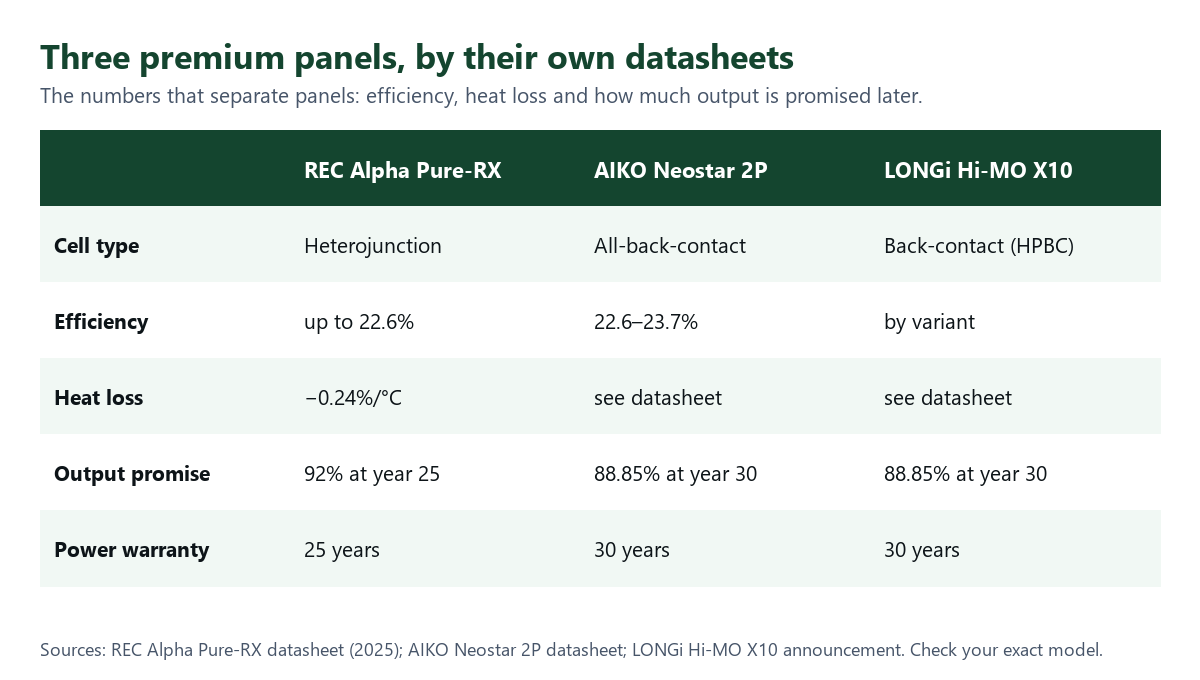
What the comparison shows: all three are strong, and the differences between them are small next to the difference a good or bad installation makes. REC publishes the clearest long-term promise (92% at year 25) and a low heat-loss figure; AIKO’s back-contact panel has the highest efficiency of the three; LONGi offers the longest power warranty at 30 years. None of these is a reason on its own to accept a higher quote.
Matching a panel to your roof
- Small or split roof: prioritise efficiency, so you fit more capacity in the space.
- Large south-facing roof: prioritise price per watt and the warranty; efficiency matters less.
- East-west roof: output is spread across the day, which can suit households at home in the morning and evening.
- Partial shading: the inverter choice matters as much as the panel. See solar inverters for optimisers and microinverters.
- Slate or sensitive roof: consider integrated products. See roof tiles and slates.
The Energy Saving Trust puts a typical home system at about 4.5 kWp. The number of panels that takes depends on each panel’s wattage, which is why two quotes for the “same” system can show different panel counts. Our guide to solar panel sizes and dimensions puts the length, width and weight of these panels side by side and works out how many fit a typical roof.
What to ignore
- “Tier 1”. A bankability list for investors, not a product-quality grade.
- Peak wattage alone. A 500W panel is bigger, not necessarily better. Compare efficiency instead.
- “Up to” efficiency. A range’s top figure belongs to its best variant, which may not be the one you are quoted.
Judging the panel on your quote
When a quote arrives, find the model number, download the datasheet from the manufacturer’s site and check the four numbers above. If the quote doesn’t name a model, ask for one before going further. Then compare installers on everything else, using the solar quotes checklist and how to choose an installer. The technology names on datasheets are explained in solar panel types.
“The cheapest panel will do.”
It may. The real risk with cheap quotes is usually the installation and the warranty behind it, not the panel. Check the installer as carefully as the product.
Whichever panel you choose, the electricity you use yourself saves the most. What you export can earn money through the Smart Export Guarantee at a rate each supplier sets.
Sending an enquiry through this site costs nothing and carries no obligation. Installers who quote should give you an itemised written quote you can take away and compare.