The UK solar manufacturers we could confirm
We started from the firms that appear on UK manufacturer lists and kept only those whose own website says they manufacture or assemble in the UK. We report what each company says about itself. We have not visited the factories, and directory listings that contradicted a company’s own site were ignored.
| Company | Where | What it makes | What it says |
|---|---|---|---|
| GB-Sol | Treforest Industrial Estate, north of Cardiff, Wales | PV Slate (solar slates), Infinity edge-to-edge solar roofs and integrated solar panels | Says it was established in 1994. 25-year warranty on PV Slate and Infinity (company figure). The company says it installs as well as manufactures, across domestic, commercial and public-sector projects. |
| Solar Capture Technologies | Blyth, Northumberland | Solar modules, integrated roof tiles (including a composite solar roof tile) and bespoke modules for marine and remote uses | The company says it has been manufacturing in the UK “for years”; no start date is given. Not stated on the page we read. Describes itself as designing, assembling and quality-checking products at its Northumberland facility. It does not say the solar cells themselves are made in the UK. |
GB-Sol (Wales)
GB-Sol is the firm most often named as a British panel maker. Its website says it manufactures solar PV panels and mounting systems at its factory on the Treforest Industrial Estate, just north of Cardiff, and that it was established in 1994. Its range is built around integrated roofs: PV Slate, designed to sit among natural slates; Infinity, an edge-to-edge solar roof; and integrated panels. The company says PV Slate and Infinity carry a 25-year warranty, and that it installs as well as manufactures, across domestic, commercial and public-sector work.
The practical point for a homeowner: GB-Sol’s products are aimed at roofs where appearance matters (slate roofs, new roofs, listed or sensitive settings, subject to consent) rather than at the cheapest kilowatt on a standard tiled roof.
Solar Capture Technologies (Northumberland)
Solar Capture Technologies, at the Photovoltaic Technology Centre in Blyth, describes itself as designing, assembling and manufacturing solar technology in the UK, and calls itself the largest solar PV manufacturer in Britain. That is the company’s own claim; we could not verify it independently. Its products include solar modules, a composite solar roof tile and bespoke modules for marine and remote uses such as navigation buoys. Its page does not say that the solar cells themselves are made in the UK; it describes assembly and quality-checking at the Northumberland facility.
Others you will see mentioned
- Viridian Solar is based in Papworth, Cambridge, and is part of Marshalls. It is known for in-roof systems. Its website did not state where products are manufactured when we read it, so treat “British company” and “British-made” as different questions.
- Oxford PV developed perovskite-on-silicon tandem cells in Oxford, and announced a residential-size module with 26.9% efficiency in 2024. Reports place its cell production in Brandenburg an der Havel, Germany. We found no UK retail route for the module.
- Older names such as Romag (County Durham) and Sharp’s former Wrexham plant appear on old lists. We found no current domestic module production from either, so check any list’s date.
What “British-made” can mean
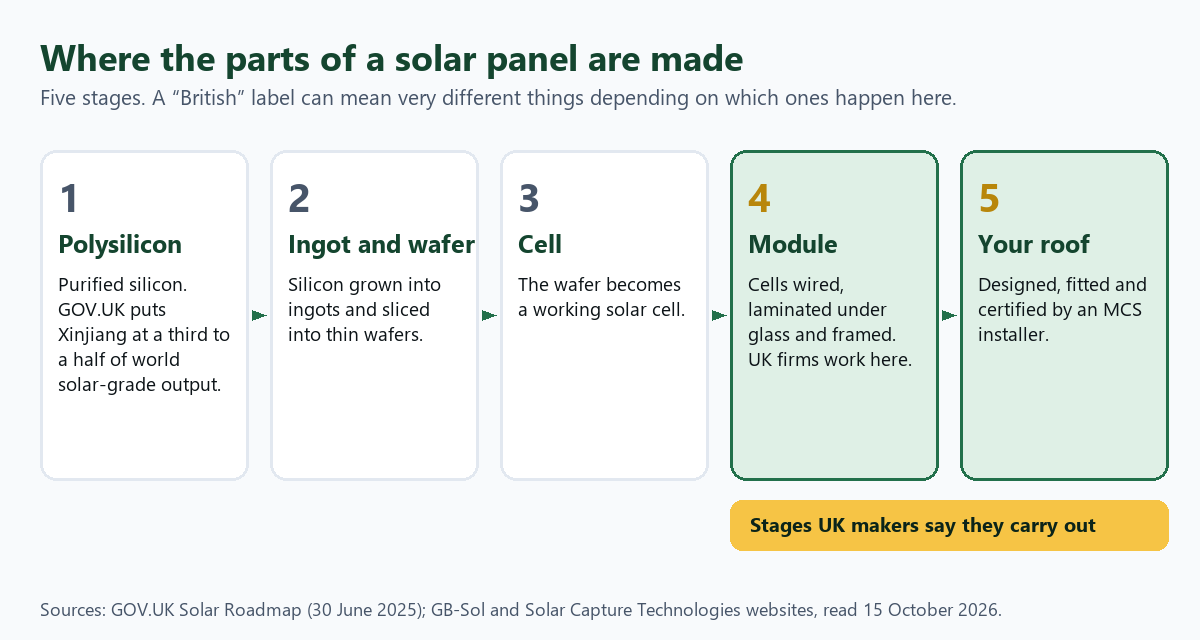
A panel is built in five stages: polysilicon, ingots and wafers, cells, the module, and the installation. A product can honestly be called British at different points in that chain, so the label alone does not tell you much.
- British brand: designed or sold by a UK company, often made abroad.
- British-assembled: imported cells laid up, laminated and framed in the UK.
- British-made product: a finished roof product (a slate or roof tile) manufactured here, usually still with imported cells.
- British-installed: any panel, fitted by a UK installer. This is what most “British solar panels” adverts mean.
Why so few panels are made in Britain
The government’s own Solar Roadmap, published on 30 June 2025, is blunt: it says the UK is unlikely to be able to compete in the existing global market for conventional solar panels, and notes China’s strong position in conventional panel manufacturing. It also estimates that Xinjiang produces between a third and one half of the world’s solar-grade polysilicon. The roadmap’s ambition is 45–47GW of installed solar capacity by 2030, and the panels for that will mostly be imported.
Where the UK can compete is in specialist products: integrated roofs, slates, tiles and bespoke modules, which is exactly where the firms above sit.
Who a British-made product suits
- Slate roofs and sensitive settings. A solar slate can look like the rest of the roof. Listed buildings still need consent; see planning permission.
- Re-roofing or new builds. Integrated products replace roof covering, which changes the cost sums when the roof is being redone anyway.
- Buyers for whom origin matters. Supporting UK manufacturing or shortening the supply chain is a legitimate reason to pay more.
It suits less well if you want the lowest cost per kilowatt on a standard tiled roof. There the comparison in best solar panels UK is the better starting point.
Questions to ask before you buy
- Where are the cells made, and where is the module assembled?
- What is the datasheet efficiency, temperature coefficient and the output promised at year 25?
- What does the product warranty cover, for how long, and who honours it if the installer stops trading?
- Is the product on the MCS product list, so the installation can be certified for export payments?
- For integrated roofs: who warrants weather-tightness, the manufacturer or the roofer?
Checking a “made in Britain” claim yourself
Look the manufacturer up on Companies House to confirm it is an active UK company, read where its website says manufacturing happens, and ask the installer for the product’s datasheet and certification. If a claim only appears in a sales leaflet and nowhere on the manufacturer’s own site, ask for it in writing.