The rules in Great Britain
- Legal since 27 August 2026 in England, Scotland and Wales, for devices that meet the required standards. Northern Ireland’s regulations differ and plug-in solar is not yet allowed there.
- Maximum 800W output for a UK-compliant device.
- One device per home at present, with the government considering allowing more.
- Register before use. The Energy Saving Trust says you are legally required to register a plug-in device on the UK Plug-in Solar Registration website before you use it, with your name, postcode and the make and model.
- Buy a compliant model. Check it is made to UK standards and on the register of approved models. The Energy Saving Trust says only a small number of retailers sell compliant kits so far.
- Where you can fix it (England): In England, permitted development does not cover plug-in solar fixed to a wooden wall, balcony or enclosure, or a timber-clad part of the building, or, for a stand-alone kit in the garden, fixed to a wooden fence, gate, wall or other means of enclosure. Those limits came in with the planning changes of 27 August 2026 (S.I. 2026/896; legislation read 30 October 2026). Check your lease and the product’s fixing instructions too.
Cost, output and savings
| Plug-in solar (Energy Saving Trust) | Figure |
|---|---|
| Maximum output | 800W |
| Yearly generation | around 700 kWh |
| Cost | around £450 |
| Bill saving | £70 to £100 a year (about £100 home all day, £70 out during the day) |
The saving estimate assumes an 800W system in Manchester, facing south at 30°, unshaded, in a home using 2,500 kWh of electricity a year. Because the power is used as it is generated, the saving is larger for households at home in the day.
Plug-in vs a rooftop system
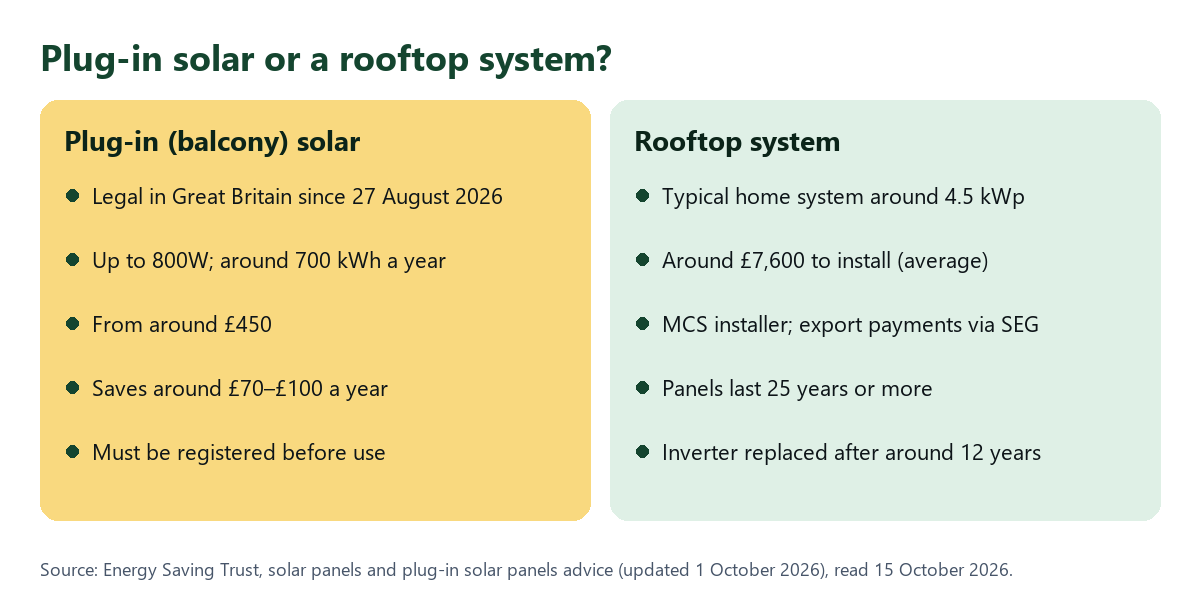
A typical rooftop system is about 4.5 kWp and costs around £7,600, according to the Energy Saving Trust. It is professionally installed, can be MCS-certified for export payments, and generates many times what a plug-in kit can. Plug-in solar is a smaller, cheaper start, not a substitute.
Export payments under the Smart Export Guarantee normally need an MCS certificate, so a plug-in kit is about using the power yourself.
Who plug-in solar suits
- Renters, with the landlord’s permission.
- Flat owners with a suitable balcony or wall, with the freeholder’s permission. Our guide to balcony solar panels walks through the checks for flats and rentals.
- Homeowners who want to try solar before committing to a roof system, or whose roof is unsuitable.
Before you buy
- Check the model is UK-compliant and on the approved register.
- Check your wiring and the socket you will use are suitable.
- Get permission if you rent or live in a flat.
- Register the device before you switch it on.
“It will cover my bills.” Not usually. At 800W it covers background loads such as lighting, TVs and computers while the sun is up. For bigger savings, look at a rooftop system: start with choosing an installer.