Finding solar installers near you
The most reliable starting point is the MCS “find an installer” search. You can search by technology and location, or by a company’s name or certification number. Each result shows the company, its certification number, the regions it covers, its certification body and the technologies it is certified for. Make sure “solar PV” is among them: a firm certified for heat pumps is not necessarily certified for solar.
Recommendations from people you know are worth having, but check those firms on the register too. You can also send one enquiry through this site; it comes to SEO-DONS LTD and we reply by email. We are not an installer and we do not vet firms, so the checks below apply to every firm you consider.
Five steps to choosing an installer
- 1. Build a shortlist. Search the MCS register by technology (solar PV) and your postcode. Add any firm recommended by people you know, then check those on the register too.
- 2. Ask for a survey, not a phone quote. A proper quote follows a look at the roof, the electrics and the shading, either in person or from detailed photos and measurements.
- 3. Compare like with like. Same system size, named panels and inverter, the generation estimate and its basis, scaffolding, any battery, and the warranties.
- 4. Check the firm. MCS number, consumer code membership (RECC or HIES), an insurance-backed warranty and how your deposit is protected.
- 5. Agree in writing. An itemised contract with payment stages, the start date and who handles the network notification and the MCS certificate.
What a good solar quote shows
| On the quote | Good sign | Ask more if… |
|---|---|---|
| Panels and inverter | Exact make and model numbers. | It says “tier 1 panels” or “premium inverter” with no model. |
| System size | kWp, number of panels and their wattage, roof layout. | The size is not explained against your roof and usage. |
| Generation estimate | An annual kWh figure for your roof, with shading accounted for. | It promises savings without showing yield. |
| Scaffolding and extras | Itemised: scaffold, bird mesh, isolators, monitoring, any battery. | Extras appear later as “site conditions”. |
| VAT | Shown at 0% for a home installation where the installer supplies and fits. | VAT is added at 20% on a domestic job. |
| Warranties | Panel product and power, inverter, workmanship, and the insurance behind it. | Only a manufacturer warranty is mentioned. |
| Payments | A protected deposit and staged payments. | Most of the price is wanted up front. |
The solar quotes checklist takes each of these line by line.
Protections to insist on
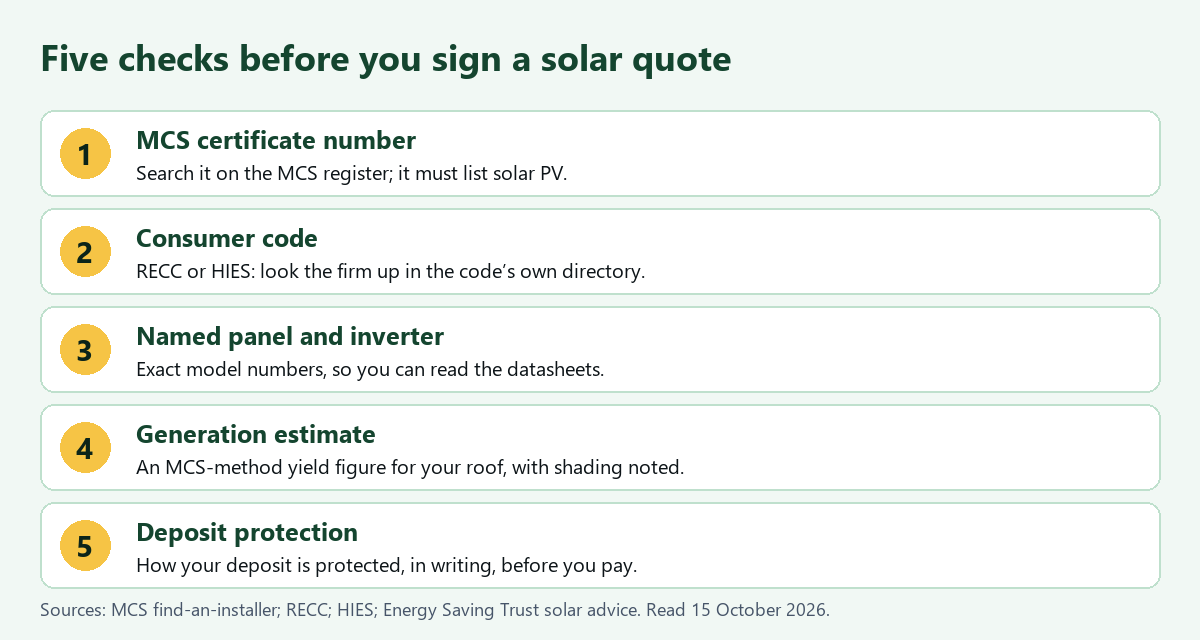
- MCS certification for solar PV. It is what export payments and the VAT relief rely on in practice. How to check it.
- A consumer code. RECC and HIES set rules on contracts, deposits and complaints. Check membership in the code’s own directory.
- An insurance-backed warranty. It steps in if the installer has ceased trading. It does not cover everything forever, so read what it includes.
- Deposit protection. Ask how your deposit is protected and get the answer in writing.
- TrustMark. A government-endorsed quality scheme some installers belong to; check it on TrustMark’s site.
Red flags: reasons to walk away
- Pressure to sign on the day, or a “price that expires tonight”.
- No MCS number, or one that does not list solar PV on the register.
- A quote with no survey, no named equipment or no generation estimate.
- Savings claims far beyond what the generation estimate supports.
- A request for most of the price before work starts, with no stated protection.
- Claims to be “government-approved” or calling “on behalf of a government scheme”. Installers are certified by schemes, not approved by the government.
After installation
Your installer should commission the system, notify the network operator (for most home systems within 28 days of commissioning), and give you the MCS certificate, the electrical certificate, warranties and the system documents. Use the MCS certificate to sign up for a Smart Export Guarantee tariff. The Energy Saving Trust says panels should last 25 years or more and the inverter usually needs replacing after around 12 years; see maintenance and aftercare. If you need planning permission, that should be settled before work starts: see planning permission.
Ask each installer how they estimate self-use versus export for your household; it is the self-use that does most of the saving, with export paid at a rate each supplier sets.